Podiatry patient accounts: payments and balances
Organize procedure, amount, payment method and outstanding balance. A fictional reconciliation example separates care, payment and tax documents.

Key takeaway
A patient account relates charges and payments to a person. It helps review recorded care, money received and outstanding balances. An internal entry alone does not establish a valid tax invoice or receipt.
This guide concerns practice administration. Keep clinical assessment distinct from payment tracking even when both relate to a visit. Define who enters a procedure, confirms a payment and can correct an amount. Billing and retention requirements depend on jurisdiction; the example is not tax advice and does not establish support for any insurance or national billing system.
Fictional payment reconciliation
| Movement | Amount in currency units | Result |
|---|---|---|
| Care recorded | Charge of 40. | Outstanding balance: 40. |
| Payment received | Payment of 25. | Outstanding balance: 15. |
| Second payment | Payment of 15. | Outstanding balance: 0. |
| Correction | Follow an authorized procedure. | Do not silently alter entries to hide differences. |
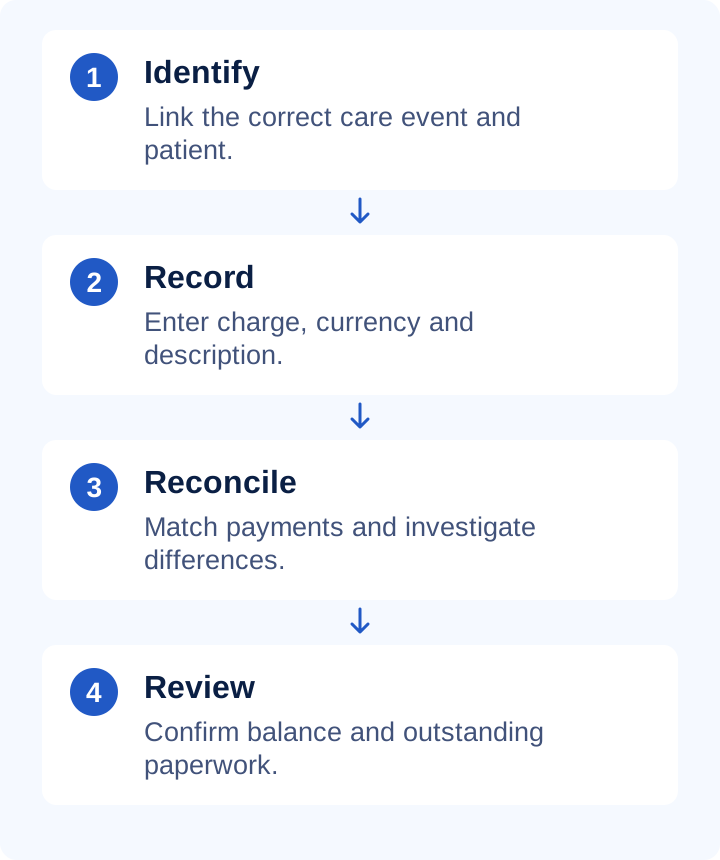
The process at a glance
End-of-day checks
Compare recorded care with confirmed payments and payment methods. An attended appointment does not prove payment occurred; an unexplained payment does not identify a care event. In the fictional table, two payments total 40 and cover the charge, without determining which tax document must be issued. Include deposits, refunds and unresolved differences where these occur in your process.
Practical checklist
- Confirm identity, description, date and currency for each charge.
- Distinguish expected amounts from money actually received.
- Link partial payments without duplicating charges.
- Define permissions and a correction/refund procedure.
- Check locally required documents with your accounting professional.
What to check in PodoClinix
PodoClinix includes patient account statements where procedure, amount and payment method can be recorded. Test how your specific workflow is represented and what documents are available. This guide announces no electronic tax invoicing, insurance integration or new PDF download; confirm such requirements individually.
A detail worth reviewing
Do not combine currencies or add percentages when assessing collections. Use matching charges and payments for the selected period and distinguish previous balances. If a difference remains unexplained, identify it for review rather than altering records to force a match. A transparent unresolved item is more useful than an apparently balanced but incorrect account.
Continue with these guides
- Podiatry software walkthrough: a complete demo test
Evaluate one fictional patient through notes, foot charts, files, appointments and follow-up. A repeatable demonstration script without real patient data.
- Podiatry progress notes: structure and example
Document a follow-up visit with reported changes, findings, assessment, actions and agreed review. Includes a fictional example and practical checks.
- Podiatry and documentation glossary
Check definitions to use terminology consistently.
Sources and scope
- Agencia Tributaria · España
Example of Spanish tax-document requirements; does not establish requirements in other countries.
Examples and checklists are editorial proposals. Adapt the workflow to your practice and local requirements. References are provided for consultation, not as endorsements of PodoClinix.
Frequently asked questions
Not necessarily. Internal payment tracking and a tax document have different purposes and requirements. Check your jurisdiction.
Run your podiatry clinic with PodoClinix
Clinical records, scheduling, WhatsApp reminders and 3D foot diagnosis. Start free, no card required.
Start free trial